

Alberta began using electricity relatively late compared to other provinces. The first power plants appeared in the 1880s and 1890s when Calgary, Edmonton, and Lethbridge entered into agreements with local entrepreneurs. How electricity was invented in general, when progress reached Alberta, and how the electricity industry developed there, can be read further at calgary-name.
Who Invented Electricity?
Although people could not fully understand the nature of electricity until the 19th century, its properties had been discovered much earlier. Around 600 BCE, the philosopher and mathematician Thales of Miletus discovered that when amber was rubbed with cloth, it attracted light objects such as feathers. This is when the concept of the electron began to develop, and the word “electron” itself is derived from the Greek for amber.
Since then, people all over the world paid attention to natural electrical phenomena like thunderstorms. However, scientific attempts to understand electricity only resumed in the early 17th century. At that time, Queen Elizabeth I’s personal physician, William Gilbert, conducted experiments with various materials to determine which ones created electric charge when rubbed. He also made many observations about how liquids and climate affected the ability of materials to generate charge. These insights later helped in the development of electrostatic machines that used friction to generate short bursts of electricity.
In 1746, Dutch scientist Pieter van Musschenbroek invented the Leyden jar, a glass container filled with water and wrapped in wire inside and out, connected to an electrostatic device. This jar could store an electric charge for several days. Another important contribution came from one of the founders of the United States, Benjamin Franklin, who attempted to capture an electric charge from a storm by conducting it through a wet thread tied to a kite, with him holding the dry thread to stay safe. The experiment was fairly successful, as the jar captured at least a small charge. This knowledge allowed Franklin to invent one of his most important inventions, the lightning rod.
At the same time, the practical application of electricity was very limited. A breakthrough that paved the way for the widespread industrial use of electricity came with the discovery of electromagnetism. In 1820, Danish scientist Hans Christian Ørsted accidentally discovered that an electric wire caused a compass needle to move. He then proposed the theory that electricity creates a magnetic field. However, the potential of this discovery was only revealed when scientists tried using magnets to generate electricity instead of the reverse.
In the early 1830s, British scientist Michael Faraday and American Joseph Henry independently discovered the principle of electromagnetic induction: an electric current can be generated by subjecting a conductor (such as a metal wire) to a constantly changing magnetic field. Faraday published his research first, so the discovery is credited to him.
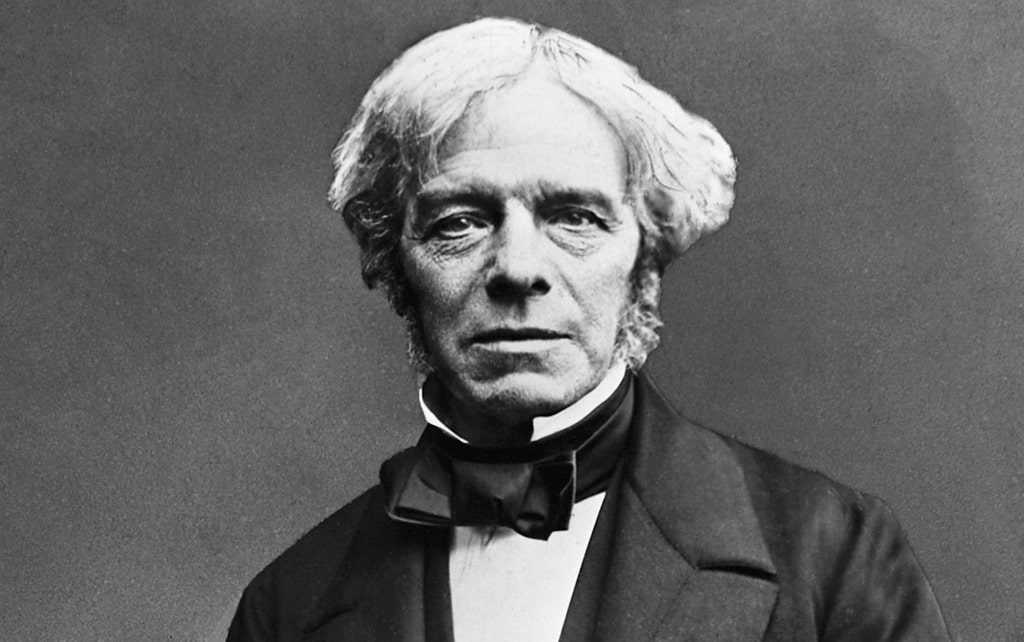
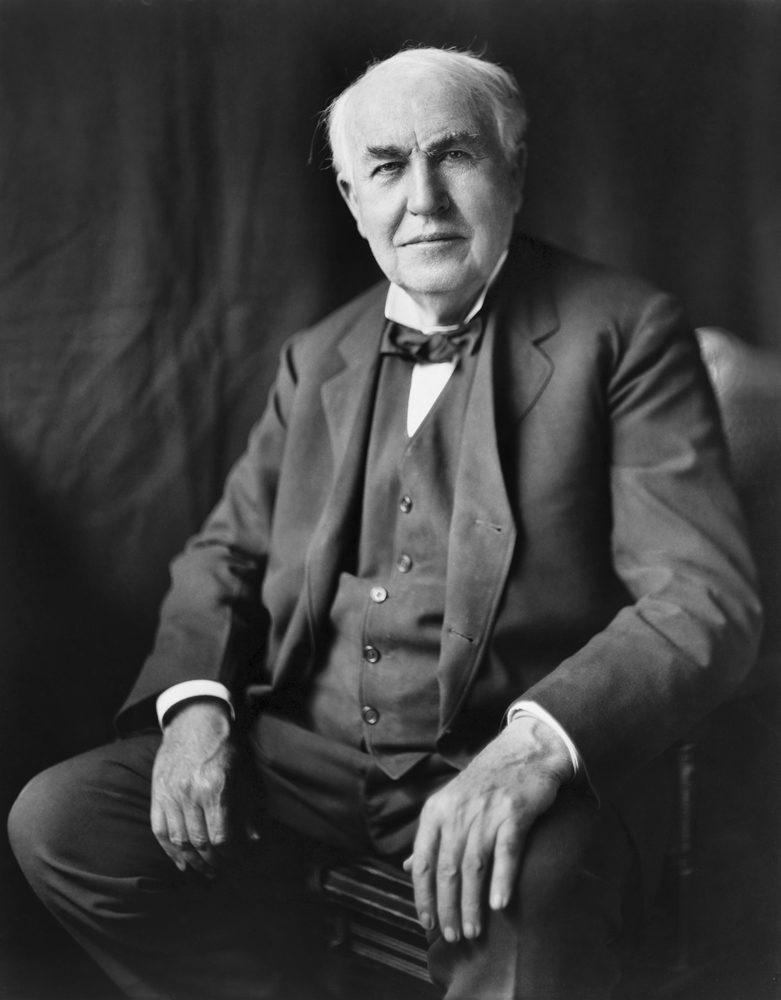
Since then, it became possible to generate continuous electric currents. The first use of this discovery was in commercial telegraphs. However, the system was cumbersome, and in 1844, Samuel Morse invented the brilliant Morse code, which only required one telegraph line. Over time, wireless telegraphs and radios were invented, and in the 1870s, American Thomas Edison created the incandescent light bulb – the first commercially viable device for producing light from electricity. He then opened a power station, which spurred the creation of power plants around the world.
Electrification of Three Alberta Cities
Calgary was the first city in Alberta to get electricity. In 1887, the Calgary Electric Lighting Company won a contract to power ten streetlights in the city center. At the same time, entrepreneur Peter Prince, who owned a sawmill equipped with a steam-powered electric generator, used the generated electricity to power his own mill and sold the surplus to commercial and private consumers in Calgary.
However, Prince wanted to have a monopoly on electricity in the city, which he achieved in 1892 when Calgary Electric Lighting Company went bankrupt. From 1894 to 1904, Prince’s company dominated the electricity market in Calgary.
Similar to Calgary, Edmonton turned to private companies to meet its electricity needs. In 1891, the Edmonton Electric Lighting Company was founded and began illuminating the city’s streets.
As for the third major city in Alberta, Lethbridge, the first coal-powered electricity generator began operating outside the city in 1874 and provided power to coal mines. The first power station in Lethbridge was established in 1893.
Government Intervention
In the early 20th century, the three largest cities in Alberta were powered by private companies. However, all of them faced serious challenges due to the rapid population growth of the province.
The most pressing problems were felt by the Edmonton Electric Lighting Company. The company’s plant was located on the banks of the North Saskatchewan River, and in 1899 and 1900, a severe flood damaged the plant. The city was left without electricity for a time. In 1902, Edmonton purchased the Edmonton Electric Lighting Company, and from then on, the management of electricity was in the hands of city officials.
In Calgary, the situation was slightly different: in 1905, the municipal government built a power station that ran on coal. However, at the same time, new private companies emerged, preventing the city from achieving a monopoly on the electricity sector. For example, the company Calgary Power (which later became TransAlta in 1981) was established.
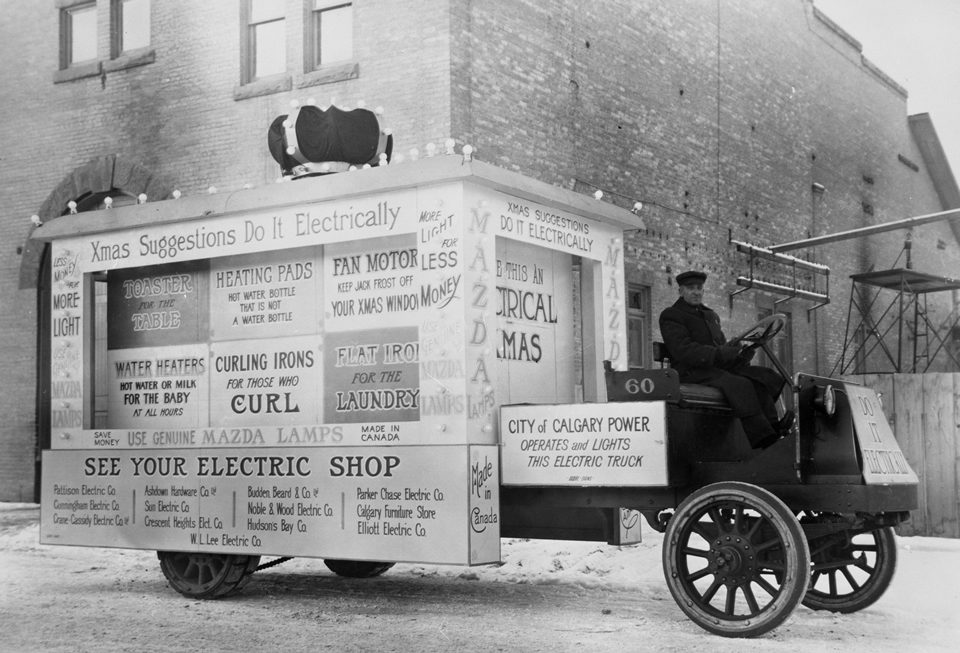
Advertising Electricity in Calgary, ca. 1910–40
In Lethbridge, the municipal government took control of electricity production and distribution in 1907 by purchasing the assets of the Lethbridge Electric Light Company and beginning construction of a new power station. Later, the old station was destroyed by fire, which forced the city to rely on the surplus electricity produced at coal mines for a period. By 1913, Lethbridge offered its residents very cheap electricity since the city government owned its own municipal coal mine and thus had access to inexpensive fuel.
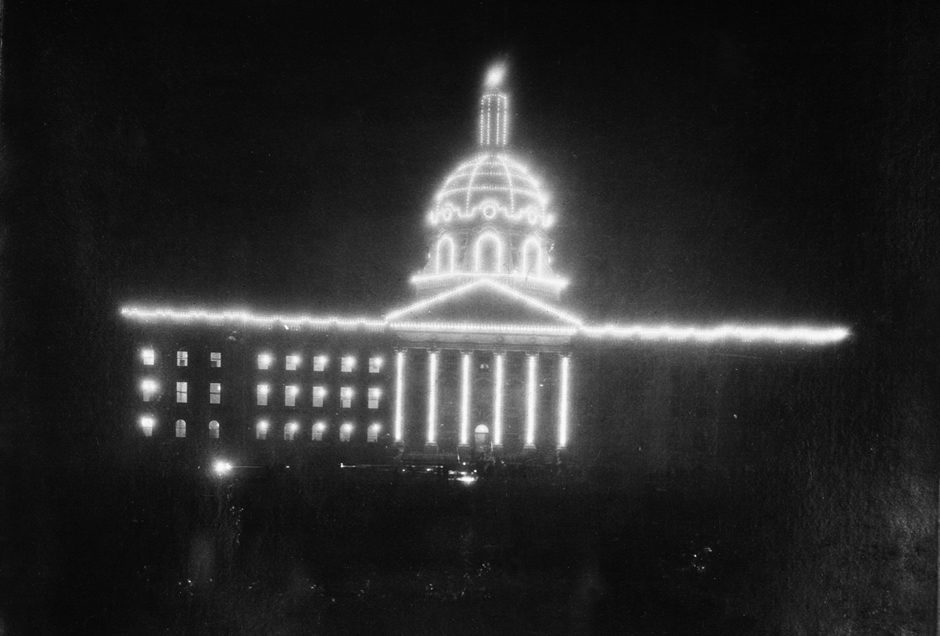
In 1911, the province also began receiving electricity from the Horseshoe Plant hydroelectric station, built by Calgary Power on the Bow River near Horseshoe Falls.
Rural Electrification
By the 1920s, electricity was still seen as a novelty rather than a necessity. The cost of electrifying rural areas was too high for both companies and farmers. However, in the early 1920s, discussions began across Alberta about the creation of a state-run public utility, where the province would take on the financial responsibility for infrastructure costs and regulate electricity prices for farmers. After World War I, the “United Farmers of Alberta” (UFA) association emerged and entered politics with great success during the 1921 provincial elections.
The UFA government estimated the cost of rural electrification at 200 million dollars, an unreasonably high price. After World War II, the need for electrification became even more pressing, as electricity was now considered a necessity rather than a luxury. Alberta lagged behind other provinces in rural electrification, with less than 4% of farms having electricity in 1945.
The rural electrification campaign received support from the Cooperative Federation of the Commonwealth. Energy companies, however, opposed rural electrification because it was not profitable for them to supply energy to rural areas; urban residents did not want their taxes spent on necessary infrastructure in rural areas; and Premier Ernest Manning, a strong advocate of social credit, was opposed to public ownership of electricity infrastructure in rural areas. In 1948, a plebiscite was held that rejected the idea of public ownership.
To resolve the issue, farmers across Alberta formed cooperatives to raise half of the necessary funds for electrification, with the remaining money provided by the government in the form of loans. By the end of the 1960s, there were already 416 cooperatives. By 1961, 87% of Alberta’s rural population had access to electricity.